Scale Your Practice

Introduction
You’ve started one clinic. Now, you want to open 10. You know someone who achieved this in 20 years — what if you want to do it in five? Scaling lets your clinic grow rapidly, so your dreams of running a group practice could be reality, sooner than you think. More than that, clinics that scale earn large profits to fuel additional growth, operate efficiently by automating work, and enjoy competitive advantages across not one, but three key areas — market differentiation, growth opportunities, and cost savings.
So why don’t more clinics scale? Scaling isn’t easy if you don’t know how or what tools to use. Plato’s “Scale Your Practice” white paper simplifies your scaling journey by helping you understand why and how to scale your practice, from setting the foundation to centralising work at HQ. Once you’ve set the right processes from this white paper in one pilot clinic, you can then quickly replicate them across each clinic in your group.
Table of Contents
CHAPTER 1
Why Scale Your Practice?

You’ve started your own clinic. Now, you’re thinking about growing your practice. You wonder: is there a way to not just grow, but grow rapidly? This is where scaling comes in.
Scaling creates three key advantages for your practice:
In chapter one of this white paper, you’ll learn how each of these benefits is relevant to you as a private practice owner or operator.
1) Exponential growth
When you scale, you’re able to rapidly increase sales while only incurring small increments in cost, resulting in exponential growth (Figure 1A). For example, let’s say you want to see 100 more patients a month to increase sales by $2,000. Normally, you might hire one more staff member to cater this rise in patient volume. But by doing so, you will need to spend $2,000 a month on the staff’s salary. As a result, your sales increase at the same rate as your costs (Figure 1B). On the other hand, if you use Plato, your clinic software scales with your practice, so you won’t need to hire an additional employee. Since Plato automates work, you can cater to 100 more patients with your current team size. Your sales increase substantially by $2,000 a month, while your costs only rise marginally — let’s say from a slight increase in utilities due to more patients at your clinic. Since the difference between your clinic’s sales and costs is profit, scaling allows your clinic to generate a larger profit (Figure 1A). The more profit your clinic generates, the more money it has to invest back into the business, so you can continue doing more of what works well for your practice. For instance, you could invest your profits into starting a new product or service line that expands your brand, giving your patients more reasons to stay loyal to your practice.
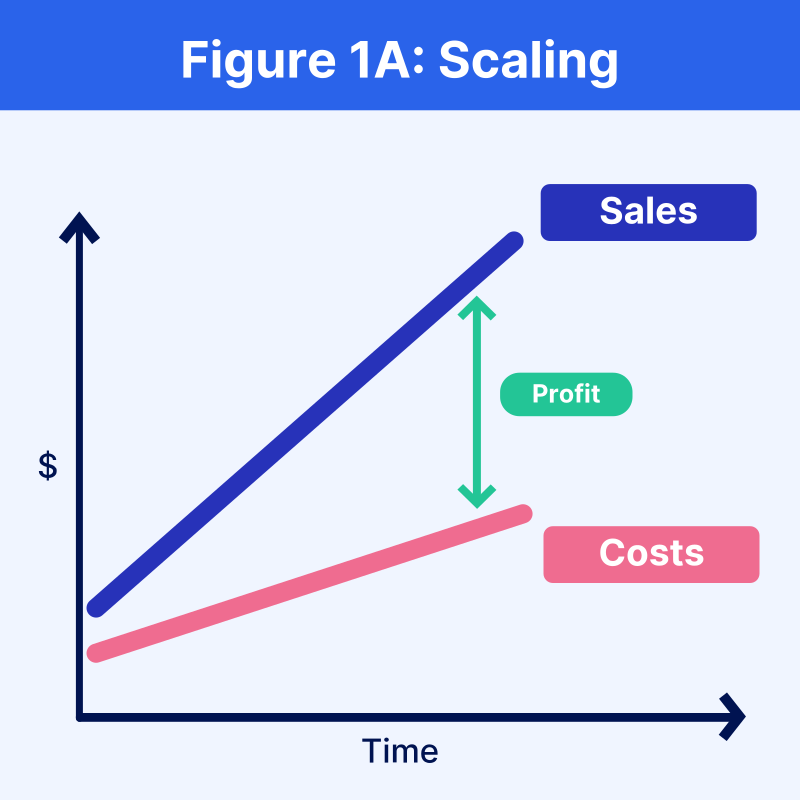
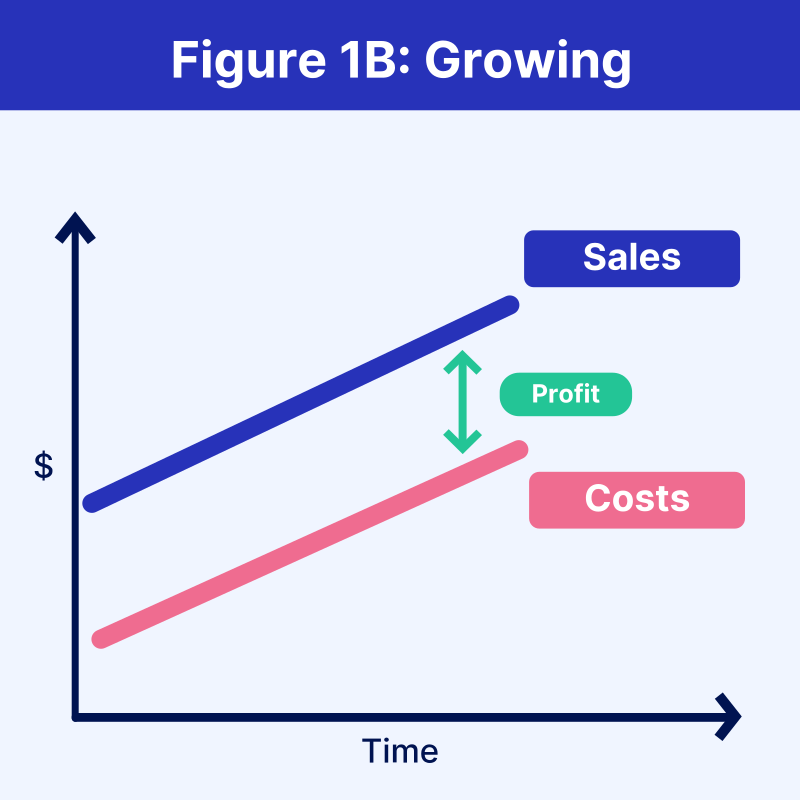
Figure 1A & 1B. Images adapted from Is there a difference between growing and scaling an agency business? (Beyond Noise, 2019)
2) Efficient operations
Clinics that scale embrace automation, so their sales are not limited by manual processes that also drive up costs. Scaling operations by automating work is crucial in healthcare because it’s a service business. Normally, service businesses will increase their spending on resources, such as manpower, to cater to a higher volume of customers. This increases their costs at the same rate as sales, slowing growth. When you automate work, your clinic can cater to an increasing volume of patients without requiring a significant increase in effort (Whatman, 2021). For example, online appointment booking scales your effort. The amount of time and energy you spend managing your clinic’s online appointment booking is the same, regardless whether one or 100 patients book their appointments online at your practice. Here’s an example of how scaling with online appointment booking impacts your clinic’s sales and costs.
Before scaling operations
Your clinic schedules 10 appointments a day by phone. Now, it wants to schedule 50 appointments a day. To do so, you need to buy more phones and hire more staff to manage phone bookings, increasing your cost from the larger amount of resources required. Your clinic’s sales rise at the same rate as costs. At this pace, you’ll require a large amount of resources just to sustain constant growth.
After scaling operations
Your clinic scales operations using online appointment booking in Plato. Scheduling is automated, so your team’s effort to manage appointment booking is the same, regardless whether one or 100 patients book their appointments online. You don’t have to hire more staff or spend on any additional software to cater to an increase in appointment booking volume. Unlike phone bookings where staff can only attend to one patient at a time, online appointment booking allows more than one patient to schedule their visit concurrently, improving efficiency. Online appointment booking reduces work for your team while improving the patient experience, since it’s accessible anytime, anywhere. Importantly, your clinic generates more sales through higher patient volume, but with only a low increment in cost.
3) Competitive advantage
Scaling creates enhanced competitive advantage for your clinic across three key areas — differentiating your practice in the market thanks to its “secret sauce”, increasing the scope of your business for more opportunities to grow rapidly, and allowing your clinic to leverage its size for increased cost savings.
First, scaleups have a “secret sauce” that’s unique and hard for competitors to replicate. Examples of “secret sauce” include technologies, operating models, and maintaining Product-Market Fit (PMF) (Ballhorn, 2022). PMF is essential for scaling (Chapter 2). PMF occurs when your clinic offers a product or service that clearly solves a problem for a large patient group with high growth potential. Since environments, markets, and competitors are constantly changing, you must continuously work to maintain PMF. This is no easy feat, as PMF involves endless experimentation as you try to figure out what works best for your business and eliminate what doesn’t.
Second, since scaleups have the advantage of catering to a large market that has high potential for growth, you enjoy greater scope to grow your business. You have more opportunities to expand your brand by adding complementary products and services, or grow towards becoming a platform. For example, imagine that your target market is young tech-savvy patients who love convenience. You understand that they value virtual care and prefer to buy their healthcare products online from a trusted source like your practice. You expand your brand by launching a teleconsultation service directly from Plato and open up an online store. Now, your patients have what they need in one place, giving them more reasons to stay loyal to your practice.
Third, scaleups are able to leverage their size and “secret sauce” to negotiate better deals with suppliers, corporate partners, and facility providers. For example, your “secret sauce” is a set of models for tracking the impact of your care. You use these models to deliver value-based care and negotiate better deals with corporate partners. Since value-based care drives improved care outcomes at a lower cost, your clinic offers greater value to corporates and their members. As a result, corporate entities prefer working with your clinic over other practices, giving you an edge over competitors.

Scaling lets you rapidly grow your practice in a cost-effective manner. That being said, if you’re a doctor who started your practice because you love building relationships with patients, then scaling might not be your cup of tea. Scaling requires you to implement processes that build layers between you and your patients. It won’t be feasible to continue building tight knit relationships with your patients as you scale your practice from one to fifty. If you decide that scaling is right for you, then your first step is to set up your foundation to scale, by determining who you serve and why.
CHAPTER 2
Set the Foundation

Who Do You Serve and Why?
According to CB Insights’ analysis of 101 startups, the top reason why startups fail is “No Market Need” (CB Insights, 2020). Of the three key elements of any startup — a great team, a great product, and a great market — the latter is the most important (Andreessen, 2007). Your market is where demand for your clinic’s products and services comes from. If people don’t want or need what your clinic has to offer — in other words, your practice has no market — it will face limited growth or fail, no matter how great your product or team is.
For example, Starbucks has a strong brand, an established team, and a great product, yet the world’s largest coffee chain failed to scale in one of the biggest coffee-drinking countries, Australia. The main reason? There was no market for what Starbucks had to offer. When Starbucks entered Australia in 2000, it failed to adjust its offerings to cater to Australians’ tastes and their coffee culture, which revolved largely around local coffee shops. Instead of slowly integrating and adapting its offerings to satisfy the market, Starbucks proceeded to open 87 stores Down Under. The lack of market ultimately stifled the brand, forcing Starbucks to close 61 of its stores in Australia by 2008 (A. Turner, 2018; Jon M. Huntsman School of Business, 2018).
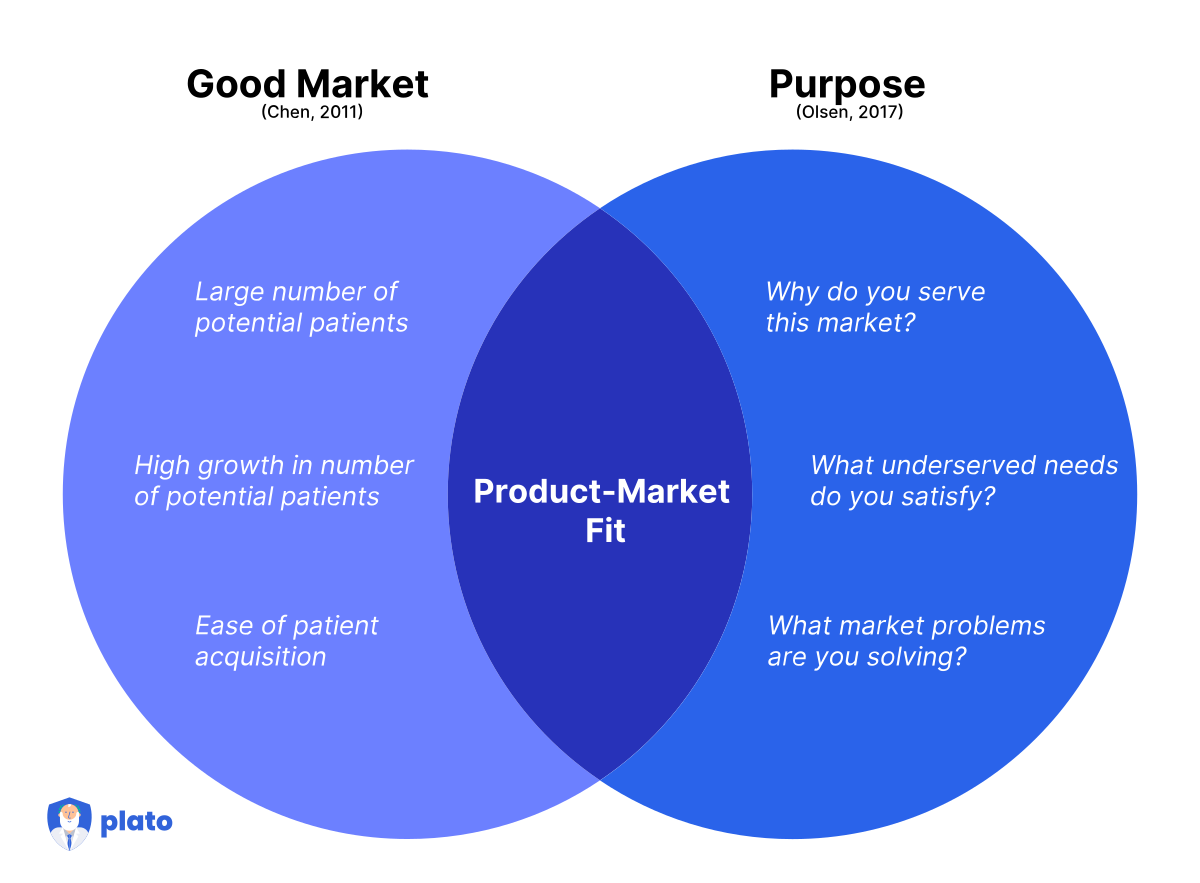
So before you can start growing exponentially, you need to know exactly what market need your clinic is satisfying. Start by figuring out who you serve (good market) and why (purpose).
Good market: A market with a large number of patients and high-growth potential.
Purpose: What underserved market need is your clinic satisfying?
When your clinic clearly solves a problem for a good market, that’s when you achieve Product-Market Fit (PMF), which is essential for scaling.
What is Product-Market Fit (PMF)?
Product-Market Fit (PMF) is a concept created by Wealthfront CEO Andy Rachleff. While there’s no official definition of PMF, author of The Lean Startup Eric Reis describes PMF as “the moment when a startup finally finds a widespread set of customers that resonate with its product.” (Head, 2018)
Why is PMF important for scaling?
PMF tells you that there's a large demand for your product or service. If you don’t know whether there’s broad market appeal for what your clinic has to offer, you’ll end up pumping money into a product or service that’s not commercially viable. This means your offering can’t successfully compete against whatever else is in the market to generate good profit. As a result, you’ll find yourself burning cash on efforts like sales and marketing without getting much positive returns (SaaS Resources, 2017).
How to know when you’ve achieved PMF
In the words of entrepreneur Marc Andreesen, PMF is when “customers are buying the product just as fast as you can make it — or usage is growing just as fast as you can add more servers. Money from customers is piling up in your company checking account. You're hiring sales and customer support staff as fast as you can.” (Andreesen, 2007)
There’s no one definitive metric to measure PMF, but here are five indicators you can use to help you determine if you’ve attained PMF (SaaS Resources, 2017).
You notice:
- A significant increase in the number of patients enquiring about your clinic and its offerings.
Example: You see substantial increase in the number of online appointment bookings in your Plato.
- An increase in the number of word of mouth referrals to your practice.
Example: When you use Plato, you can ask your patients how they heard about your clinic during online appointment booking. Then, under Plato’s “Intelligence” > ‘Referral Sales Report’, track which patients came in from which referring entity, so you know what channels are most effective for word of mouth referrals.
- More patients come into your clinic, pay for your products and services, and gain value from their experience.
Example: Go to Plato’s “Intelligence” > ‘Patient Sales Report’ to track the number of patients who visited your clinic over a period of time, the number of visits by each patient within this time frame, the amount of sales from each patient, and what products or services they paid for.
- A rise in the number of repeat patients at your clinic, while the number of patients who only come in once to your practice stays low.
Example: Go to Plato’s “Intelligence” > ‘Visit Types’ to see the number of first and follow-up visits by your patients over a specific period of time.
- An average score of eight to 10 for any Net Promoter Score (NPS) survey you run. An NPS survey determines how loyal your patients are to your clinic. NPS involves asking respondents to rate the probability they’d recommend your practice to others.
Example: Plato is integrated with Typeform, a user-friendly software that lets you build interactive online surveys without any coding knowledge. Use Typeform’s NPS survey template to gather feedback from your patients, directly from your Plato.
Does this mean once you’ve attained PMF, you can forget about using these indicators ever again? No, because you’ve to continuously work to sustain PMF.
Maintaining PMF is constant work
One common myth about PMF is that once you’ve achieved it, you can’t lose it. On the contrary, working to maintain PMF is unceasing. Since environments, markets, and competitors are always changing, your clinic must continuously work to maintain PMF, so as to satisfy evolving market needs. Sustaining PMF isn’t easy as it requires continuous experimentation. You need to figure out how to improve your products or services to meet market demands through trial and error, then double down on what works and eliminate what doesn’t (Kelsey, n.d.).
Achieve and sustain PMF using data
Use data analytics to work more efficiently towards achieving and maintaining PMF. For example, Instagram’s co-founder Kevin Systrom used data analytics to find the app’s PMF. Instagram was initially launched as Burbn, an app that wasn’t experiencing much success. Systrom used analytics to discover exactly how Burbn’s users were utilising the app. He discovered the majority of the users were interested in the app’s photo-sharing features. Instagram’s founders doubled down on improving the app’s photo-sharing capabilities and got rid of everything else, resulting in the Instagram that you know today (Garber, 2014). Till now, Instagram continues to use data analytics to better understand its users’ behaviours and preferences (Hollington, 2022).
Could maintaining PMF be your “secret sauce”?
Since the ability to maintain PMF is hard for competitors to replicate, this skill could even be considered a clinic’s “secret sauce”. For example, imagine your clinic partners with corporate entities, such as hospitals, insurers, or third-party payors, to bring in a higher patient volume. As healthcare evolves, the industry’s interest in Value-Based Care (VBC) grows. VBC provides greater value to corporate members since it focuses on delivering better patient outcomes at a lower cost. However, implementing VBC is complex. You need the right technology to collect quality structured data to monitor patient outcomes, allocate resources, set budgets, and coordinate care. Your clinic experiments with a set of models to measure the impacts of your care. It manages to establish a model to measure VBC. You use this model and your clinic’s VBC results to negotiate better contracts with existing corporate partners. The model performs well. You improve it further and use it to expand your corporate network by partnering with more corporate entities. Your clinic then becomes the preferred choice for corporate entities to partner with due to the greater value offered by your clinic to their members.
When you first achieve PMF, you’ll notice a rapid increase in patient demand for your clinic’s products and services. Once you’ve determined that there's a large demand for your clinic’s offerings, it’s time to scale your practice.
Start Scaling
You might’ve imagined scaling to resemble a straight line (Exhibit A below), but in reality, scaling more closely resembles the model in Exhibit B, where new channels, products, and markets generate a rapid increase in sales (Mullany, 2016).
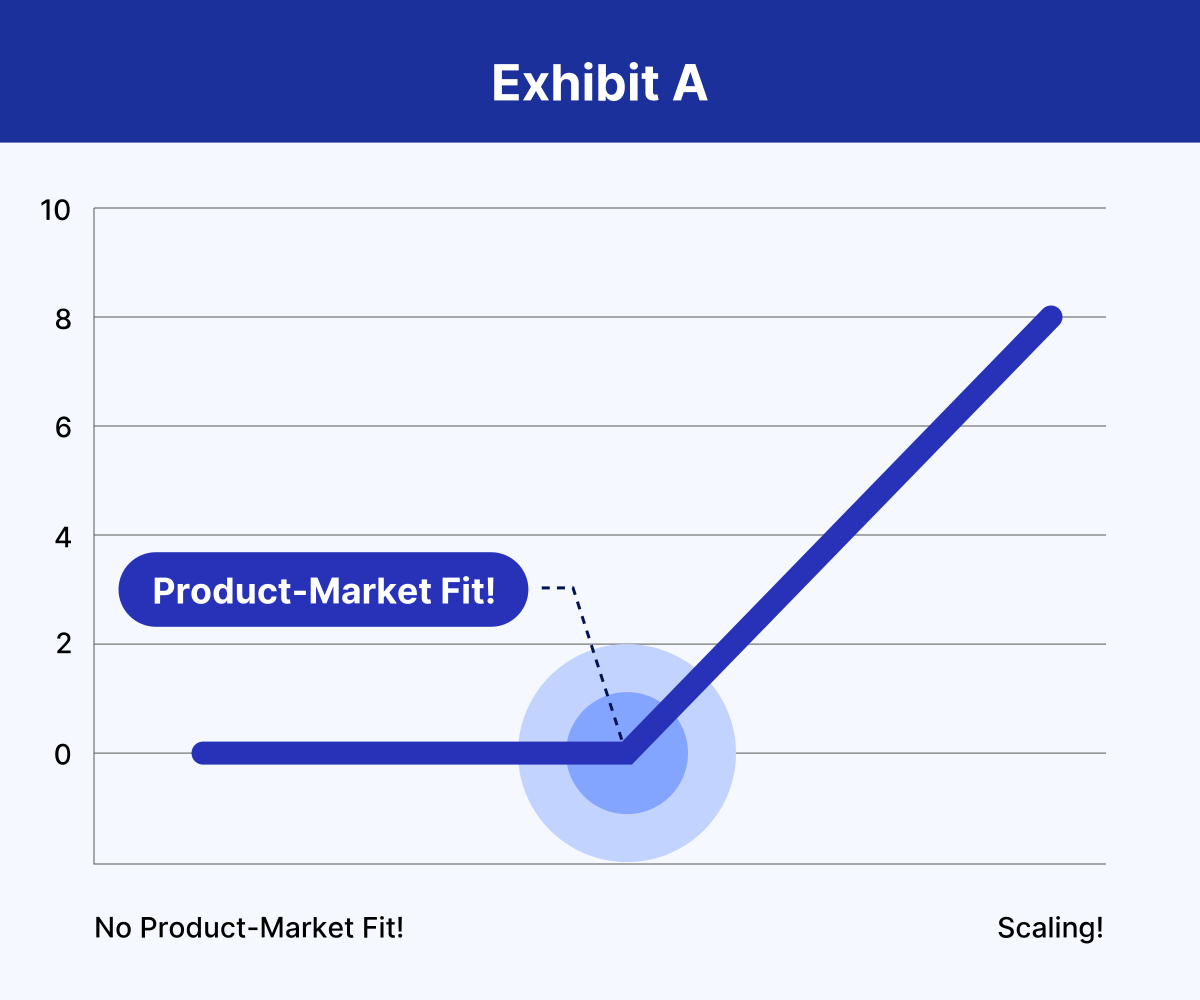
Exhibit A. Scaling doesn’t happen in a straight line. In reality, scaling more closely resembles the model in Exhibit B (below). Image adapted from Beyond Product Market Fit: Scaling Go To Market (Mullany, 2016)
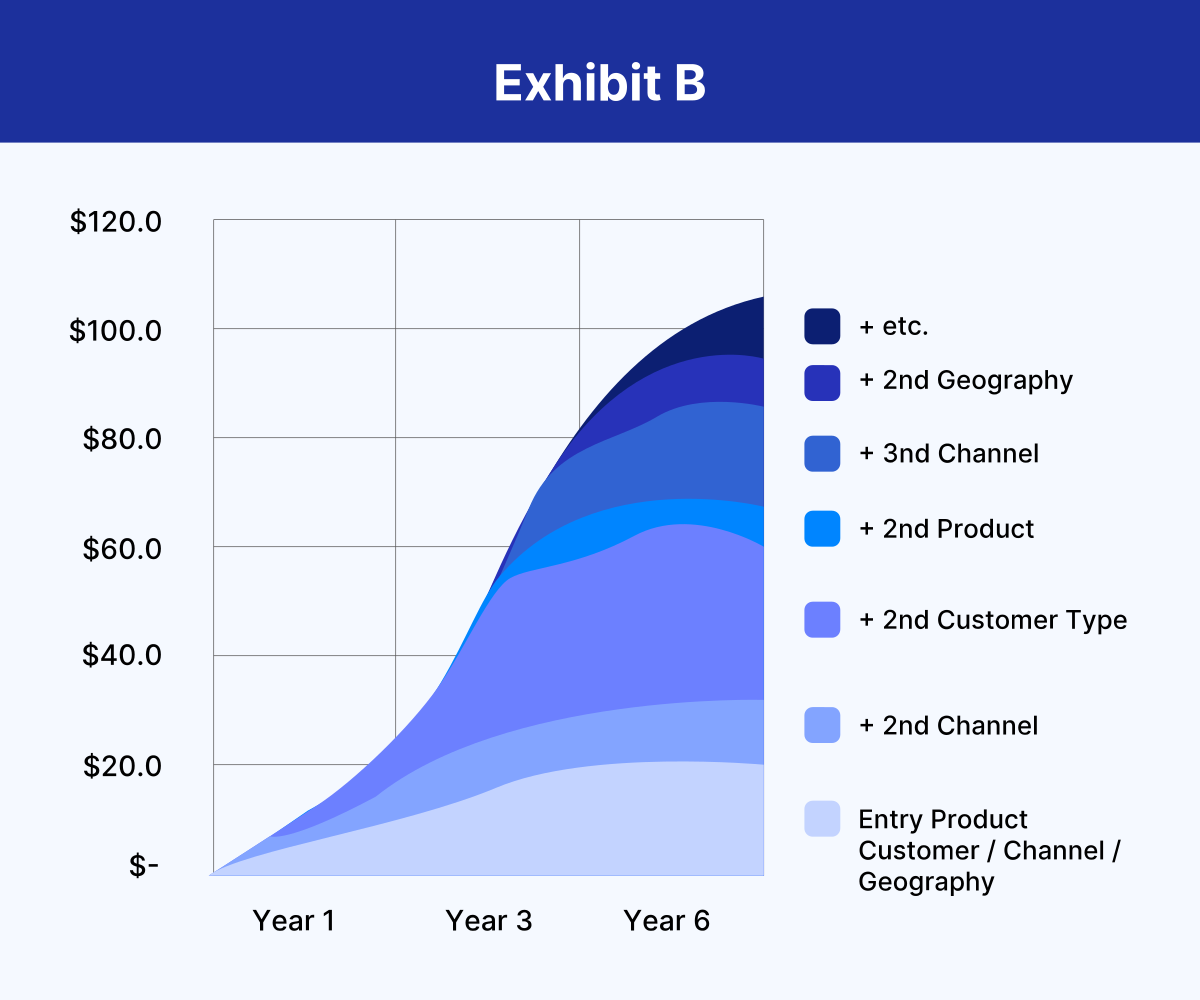
Exhibit B. Realistic scaling model, where new channels, products, and markets generate an exponential increase in sales. Image adapted from Beyond Product Market Fit: Scaling Go To Market (Mullany, 2016)
When your clinic first achieves PMF, it will almost instantly attract new competitors and saturate easy channels. To scale your clinic beyond initial PMF, you must develop new ways to deliver value to your patients, with help from scalable business models.
Scalable business models
Think of a scalable business model as your clinic's value chain. Your business model helps you determine how you are going to continue bringing value to your patients. Since scaleups have to stay agile and maintain small increments in costs, scalable business models must be flexible and generate an exponential increase in sales with every additional resource. Nielsen and Lund (2017) have identified five patterns of scalable business models that will help your clinic accelerate sales.
Five Attributes of Scalable Business Models
1) Add new distribution channels
A distribution channel is the means through which your products or services reach patients. New distribution channels could help your clinic penetrate the market by expanding its reach, improving sales, and distributing overhead costs.
Example: Increase your patient volume by growing your referral network or expand your reach by acquiring companies that complement your clinic business. For instance, CVS Health acquired Target’s 1,672 pharmacies across 47 states to widen the reach of CVS Pharmacy and its retail clinic service, MinuteClinic (CVS Health, 2015).

How can I apply this to my clinic?
Start managing your new clinic location using Plato. Increase your clinic’s sales by expanding your market reach — set up a new clinic location and start managing it instantly from Plato. Plato grows with practice, so you have everything you need in one place, regardless whether you run one clinic or fifty. Set up a multi-location calendar, billing rules, access restrictions, and patient communications by clinic location, all from one platform: Plato.
2) Overcome traditional capacity constraints
Capacity constraints include resources, equipment, policies, procedures, or people that limit your clinic’s operations. Removing capacity constraints can result in notable increases in your patient volume and sales (Cox et al., 2014).
Example: Cataract surgeries at Aravind Eye Hospital are delivered using an “assembly line” approach. Each operating room has one surgeon, minimum two operating tables, and a team of nurses for non-surgical tasks. While the surgeon treats one patient, nurses prepare the other patient for surgery. This approach enables the team to work on six to eight patients per hour, instead of one patient per hour (Krishnan, 2015).
How can I apply this to my clinic?
Bring back patients by pairing recalls with online appointment booking in Plato. Calling patients back one by one for their follow-up is slow. Let your team focus on patients in the clinic by setting up automated recalls in Plato. Recalls are reminder messages sent to patients due for a follow-up or medicine refill, inviting them to book their next appointment at your clinic. Include your clinic’s appointment booking link inside each recall message, so patients can book their next visit instantly. Bring back patients to your clinic easily and grow your loyal pool of patients — start setting up automated recalls and online appointment booking in your Plato today.
3) Shift capital requirements to partners
Capital requirements refer to the financing needed to operate a business. Since companies place a high value on cash, passing on capital requirements to partners can be desirable and help accelerate growth.
Example: Walmart quickly expanded its retail clinic network by partnering with Oak Street Health to bring its clinics into Walmart’s supercenters (Pifer, 2020).
How can I apply this to my clinic?
Set up a virtual clinic using PlatoConnect. Want to consult patients online without the hassle of searching and paying for a reliable third-party teleconsultation software? Plato has what you need. Deliver virtual care instantly by setting up PlatoConnect in your Plato. Let your patients and their caregivers consult securely with you from wherever they are. Support your patients beyond borders, from teleconsultation to prescription delivery and remote payments.
4) Leverage the work and resources of partners
Work with partners who have the resources and strengths to complement your practice. Strategic partnerships optimise your clinic’s value propositions to patients and open doors for growth.
Example: Radiology Associates of South Florida stays at the forefront of technology by leveraging on MEDNAX’s connections with physician groups and its new technology, like machine learning (IOLearning, 2017).
How can I apply this to my clinic?
Build patient loyalty by sharing notes from Plato. Good provider teamwork is the greatest predictor of patient loyalty. When care is safe and well-coordinated, patients are more likely to recommend your practice (Press Ganey, 2019). Imagine you’re a GP. You work with specialists and allied health professionals to care for chronically ill patients. Each team member provides their own expertise and analysis of the patient’s condition. Together, your team must reach a consensus on the patient’s treatment based on their analyses and combined proficiencies. By sharing notes, your team improves collaboration, decision making, and outcomes (Smith et al., 2018; TigerConnect, 2020). Start driving improved patient results at your clinic by sharing your first note with your colleague, regardless whether they use Plato.
5) Implement platform models
Businesses that use platform models are able to provide everything their customers need on one platform, giving them more reasons to stay loyal to the company. Platform-based business models operate on the basis of collaboration and can be seen as an extension of leveraging on partners.
Example: Mayo Clinic Platform partnered with Medically Home, a tech-enabled clinical company, to expand its network and overcome capacity constraints. By using Medically Home’s technology to offer teleconsultations, organise medicine delivery, and schedule home visits for patients, Mayo Clinic hospitals could free up their beds for more serious patient cases and reduce their overall costs of care (Anastasijevic, 2020).
How can I apply this to my clinic?
Plato has everything your patients need on one platform. At every stage of the patient journey, Plato automates work, so you can deliver greater value to patients, giving them more reasons to stay loyal to your practice. For instance, patients can book their appointments online — anytime, anywhere. New patients register automatically by sharing their biodata from Singpass to your Plato, eliminating form-filling and reducing their wait times. With Plato, your patients can go paperless too. Issue DigiMCs and send digital consent forms to patients, even in advance of their visit. Let patients pay remotely for their virtual visits or online purchases using “Card not Present” PlatoPay. Improve adherence and outcomes by sharing notes with patients, like visit summaries, care plans, and direct lab/radiology results.
As you scale your practice, you’ll experience a rapid increase in patient volume. In chapter 3, you’ll learn why and how to reduce work at each clinic and move core processes to HQ, so your practice can keep up with the market demands.
CHAPTER 3
Reduce Work at Each Clinic
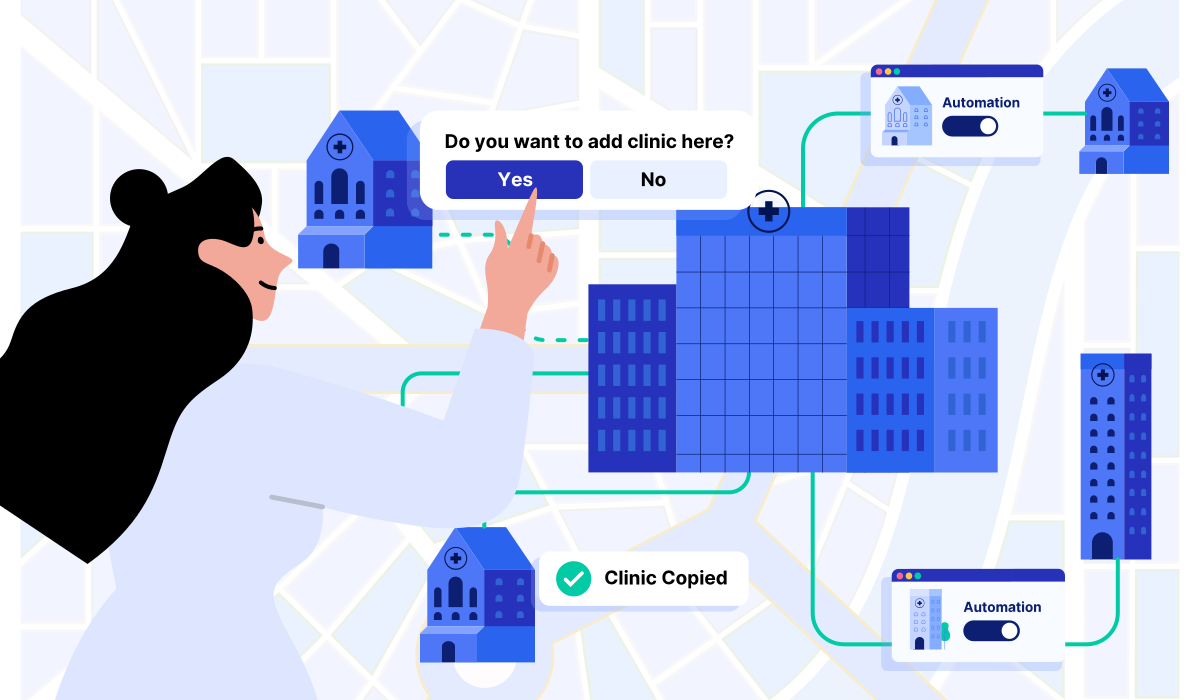
You’re scaling your practice and see a rapid increase in patients, but your internal operations can’t keep up — your processes are fragmented, admin-intensive, and slow.
Help your clinic keep pace with rapid growth in two main ways:
When you automate work at each clinic, you can ensure you are scaling up efficient processes — as you add clinics and distribution channels, your team can focus on creating a strong impression on patients and growing your brand. It’s important to scale up good practices instead of building up inefficiencies in your business.
Centralising core processes at HQ lets you focus clinics on patient management. Processes like corporate billing, appointment management, and reporting are more quickly completed by specialised staff at HQ. More than that, centralisation also lets your group leverage its size for cost savings through bulk orders, and better supplier or partner deals.
Let’s start by understanding why your practice should automate work at each clinic.
Why automate work at every clinic?
First, automation frees your staff to focus on higher value tasks that can’t be done by technology. For example, software can’t care for patients, but it can minimise data entry and repetitive tasks, giving your team time to build relationships with patients.
Second, as your clinic scales, its processes will also need to scale to keep pace with the spike in market demand. Since scaling involves “duplicating” clinics across your group practice, establishing automation best practices at one pilot clinic location lets you subsequently replicate these automations quickly across every clinic — and cater to a higher patient volume without stretching your team. If your processes are not efficient, suboptimal workflows will likewise scale inefficiencies, building and growing challenges for your team. For example, if your clinic uses paper registration, inefficiency scales as your clinic scales. The more new patients you receive, the slower your clinic’s registration process becomes, since your clinic can only register one patient at a time with paper. On the other hand, if you scale efficiency using digital registration, your clinic can automatically register multiple patients at the same time, speeding up work and reducing wait times in your clinic.
Below are three ways you can start reducing work at each clinic using Plato: automate work at your front desk, for your healthcare team, and to build patient relationships.
How to reduce work at each clinic
1) Automate your front desk
Clinics that run an automated front desk are able to cater to a larger patient volume without increasing their team size. Since automation scales your front desk operations, you don’t need additional resources to accommodate an exponential rise in appointment bookings, patient registrations, or medical billing and payments.
- Grow your clinic with online appointment booking: Let patients book their appointments online while automating scheduling for your front desk. Allow patients to prepay for items upfront when they book their appointment. You set the rules — block slots, set appointment lengths, or require patients to put their credit card on file to finalise a booking.
- Speed up work with online registration: Set up pre-registration or self-registration in Plato. Because of special Govtech innovations, clinics in Singapore and Malaysia can link their Plato with Singpass and MyKad respectively to automate registration using patients’ verified biodata. Digital registration speeds up patient processing and reduces data entry for both patients and staff. Add a digital consent form to pre-registration, so patients can review and sign their consent form, prior to their visit. Let patients share files with your clinic at online registration, eliminating scanning for your staff.
- Simplify medical billing and payments: Use the PlatoPay Terminal to eliminate double data entry and reconciliation errors, saving hours of work. Simplify corporate billing by managing it from within Plato — set pricing rules to ensure every bill is correct, track claim submissions and record corporate payments, so you know who paid what, and when.
2) Save time for your healthcare team
Reduce work for your doctors and nurses, so they can attend to a higher volume or value of patients. Allow them to work efficiently using Plato’s flexible EMR that has everything they need on one platform.
- Let your doctors take notes, their way: Every doctor works a bit differently. Plato’s flexible EMR adapts to each physician’s workflow, so they are not limited by their clinic software. Let them type, write, draw, or use speech-to-text, speeding up documentation so they have more time to attend to patients.
- Minimise repetitive data entry: Let your doctors and nurses focus on high-value tasks by eliminating repetitive work. Create a template once in Plato, then use it a thousand times. Automate note and referral writing with templates and build forms to collect structured data for value-based care.
- Everything they need is in one place: Plato’s integrated EMR has everything your doctors and nurses need on one platform. Regardless where your clinic is located, your team can send digital consent forms and share notes with colleagues, patients, or caregivers, directly from Plato. For clinics in Singapore and Hong Kong, get direct lab/radiology results in your Plato EMR.
3) Build patient relationships with less effort
A strong patient-provider relationship improves patient loyalty (Press Ganey, 2015). As your patient volume grows, your clinic must find a way to maintain a strong relationship with patients without a significant increase in staff’s time and effort.
- Bring patients back using recalls: Imagine how much time your staff will need to contact patients manually to bring them back for their follow-ups. Save time by setting up automated recalls. Send a personalized reminder message to your patients using email or SMS that includes your clinic’s appointment booking link, reminding them to schedule their next visit online instantly.
- Share notes to improve outcomes: Generally, patients find it hard to recall verbal medical information. Sharing notes helps patients accurately recall what was discussed in visits, understand their health condition, and improve their adherence to drive better outcomes. Since note sharing helps patients take greater control of their care, it also strengthens patients’ trust in their provider (Delbanco et al., 2012; Tapuria et al., 2021; Vahdat et al., 2014).
Reducing work at each clinic also includes centralizing core processes at HQ.
Why centralise work at HQ?
Streamlining processes at HQ lets your staff focus on specialised areas to produce higher quality results. For example, corporate billing is a crucial but complex process due to varying corporate billing requirements. When corporate billing is managed individually at each clinic, staff have less time for patients. Their attention is split between patient care and billing work, reducing their overall efficiency and performance (Cleveland Clinic, 2021). Centralising corporate billing at HQ frees your clinic teams to focus solely on patients. At HQ, your dedicated corporate billing team works faster and more accurately to ensure all claims are submitted and paid across your group practice.
As your clinic scales, it also increases in size, creating cost saving advantages for your company. Consolidating key processes at HQ gives your group practice the leverage it needs to negotiate better deals with suppliers and partners. For example, your group practice compiles inventory requests from all your clinics into a bulk order at HQ. Since your group is making orders in large quantities, your supplier charges a lower price for each unit and adds in quantity bonuses, reducing your overall inventory cost.
Start centralising your operations at HQ with these four key processes using Plato.
Four key processes to centralise at HQ
1) Centralise appointment booking
Many clinic groups will bring appointment booking to their HQ, allowing them to streamline appointment bookings through a call centre. Leaving your clinic staff to manage appointment bookings takes their time away from patients in your practice. When you use Plato, your clinic can manage appointment booking centrally with fewer staff and even supplement it with online appointment booking. Standardise online appointment booking details across all your clinics, such as appointment lengths, whether patients need to put their credit card on file to finalise a booking, or allow patients to prepay for items when they book their appointment online. Control who can change these appointment settings under ‘Access Restrictions’ in your Plato.
2) Corporate billing
Simplify corporate billing by managing it centrally at HQ, ensuring every claim is submitted and paid across all your clinics.
- Ensure every claim is submitted and paid: Track claim submissions across all your clinics from within Plato. Speed up payments by giving corporates the correct documents, so you meet the requirements of hospitals, insurers, and third-party payors. Ensure every claim is paid by tracking corporate bills in Plato and recording payments in bulk, so you know what was paid by who and when.
- Allow claim amendments only at HQ. Despite your clinic’s best efforts, an error could be made while making a claim, or a corporate could reject an item on an invoice. Your clinic has to then amend both the invoice and the claim. Centralising claim amendments at HQ increases control and prevents misuse of processes. There are two ways to manage amended claims in Plato. The first is to issue a credit note — this is more complex to manage and better handled by HQ. The second is to amend the original invoice — managing this at HQ minimises misuse or unauthorised access to your clinic’s data and processes.
- Manage rejected claims at HQ. In the event a claim is rejected by a corporate entity, the outstanding amount is then billed to the patient, who has to settle their rejected claim. Instead of having clinic staff contact patients, leave it to HQ to manage rejected claims centrally. Let HQ contact patients, requesting them to settle their rejected claims remotely using “Card not Present” PlatoPay. This saves patients the hassle of returning to your clinic to pay, speeding up settlement and minimising the likelihood of bad debt.
3) Implement a full procurement flow
Negotiate lower prices and quantity bonuses from suppliers by implementing a full procurement flow from Plato. Consolidate orders from all your clinics at HQ to create a bulk purchase — and reduce costs. Plato’s full procurement flow includes Purchase Requisitions, Purchase Orders, and Supplier/Delivery Orders. Purchase Requisitions let your front line input what should be bought and sold. Purchase Requisitions can then be consolidated into Purchase Orders to ensure goods are only purchased with proper approvals. Finally, Supplier/Delivery Orders can be used to record order receipt and complete a three-way match, ensuring the correct items are ordered, delivered, and charged to your group practice. Plato’s Procurement Flow is recommended for large groups where written coordination and approvals are critical. Plato’s full procurement flow can be opened on request by emailing support@platomedical.com.
4) Data reporting
Centralising data reporting gives your clinic the insights it needs to develop the business and simplify commission calculations.
- Discover new ways to grow the business: Let’s say your clinic’s “secret sauce” is an “assembly line” approach similar to Aravind Eye Care System. You use custom analytics in Plato to track the average number of patients your team treats per hour and the number of patients who fully recover post treatment. The data shows your clinic is able to deliver better patient outcomes at a lower cost, in other words, value-based care. You use this data to win better contracts with new corporate partners, expanding your referral network and attracting more patients to your practice, fueling its growth.
- Simplify commission calculations using Plato’s “Intelligence” reports: Save time and minimise errors from tedious manual calculations in spreadsheets. Automate reporting using Plato so your staff receives commission payments accurately and on time. There are two ways you can track commissions in Plato:
- By individual providers — Used when commissioned procedures or sales for each patient is done by a single provider. E.g. One dentist treats the patient during each visit. In Plato, automatically generate the revenue earned or payments collected by individual providers using its “Provider Sales Report”.
- By individual line items — Used when commissioned procedures or sales during each patient’s visit is carried by more than one staff member. E.g. Consult is done by the doctor, injection is done by an aesthetician, and a sales package is sold by the front desk staff. In Plato, you can manage complex commission tracking by individual line items using its “Items Dispensed” report.
In chapter 4, find out what compliance requirements your practice should follow as it scales beyond the legal definition of a “small company”.
CHAPTER 4
Compliance Requirements

Each year, companies in Singapore are legally required to file specific reports to respective government bodies. Compliance requirements include your company’s annual financial statements, annual general meeting, annual return filing with ACRA and annual tax return filing with IRAS. Businesses that are GST- and non-GST registered must also keep proper records for income tax and GST purposes. Check with your corporate secretary about your practice’s compliance requirements for clarity.
Implement good accounting practices from day one. Practising good accounting habits from the get-go ensures your practice produces accurate financial statements to meet compliance requirements and support business decisions. As your clinic scales, its finances and transactions will grow more complex. Reliable accounting from day one keeps your business transactions well organised, so that it’s easy to pull up accurate documents for compliance, loans, tax relief, management and growth decisions. Check that you maintain good accounting practices and financial management by having your company independently audited.
The importance of annual audits for companies — big and small. Audits help companies of all sizes maintain effective internal controls to meet business objectives, create accurate financial reports, minimise cost of capital and prevent fraud. For listed companies, audits are especially important to ensure financial credibility and gain shareholder trust. For example, after payment firm Wirecard was independently audited in 2020, the company was exposed for fraud and accounting malpractice. Wirecard filed for insolvency following the exposé. At its peak, Wirecard was listed on Germany’s DAX stock index. “Small companies” that are legally exempted from being audited may actively choose to be reviewed to keep checks on their internal controls. According to ACRA, your practice is a “small company” and exempted from audit if:
- it is a private company in the financial year in question; and
-
it meets at least two of following criteria for immediate past two consecutive financial years:
- total annual revenue ≤ $10m;
- total assets ≤ $10m;
- no. of employees ≤ 50.
Once your practice no longer meets the legal definition of a “small company,” its financial statements and accounting records must be audited annually in accordance with the law.
Scale with Plato
Thank you for reading Plato’s white paper, we hope you enjoyed “Scale Your Practice”. Plato scales with you, automating work for your front desk, doctors, and HQ. Whether you run one clinic or fifty, Plato has everything you need in one place. If you need help scaling your clinic’s operations using Plato, book a training session here: https://platomedical.com/meet/ct
References
Anastasijevic, D. (2020). Mayo Clinic launches advanced care at home model of care. Mayo Clinic. https://newsnetwork.mayoclinic.org/discussion/mayo-clinic-launches-advanced-care-at-home-model-of-care/
Andreessen, M. (2007). The only thing that matters. Pmarchive. https://pmarchive.com/guide_to_startups_part4.html
Ballhorn, K. (2022). 14 Companies Share the Secret Sauce to Scaling. Built In NYC. https://www.builtinnyc.com/2022/05/13/14-companies-share-secret-sauce-scaling
Beyond Noise. (2019). Is there a difference between growing and scaling an agency business? Medium. https://medium.com/@gareth.healey/is-there-a-difference-between-growing-and-scaling-a-business-8d110a334a6b
CB Insights. (2020). The Top 20 Reasons Startups Fail. CB Insights Research. https://www.cbinsights.com/research/startup-failure-reasons-top/
Chen, A. (2011). When has a consumer startup hit product/market fit? Andrewchen.Com. https://andrewchen.com/when-has-a-consumer-startup-hit-productmarket-fit/
Cleveland Clinic. (2021). Why Multitasking Doesn’t Work. https://health.clevelandclinic.org/science-clear-multitasking-doesnt-work/
Cox, J. F., Robinson, T. M., & Maxwell, W. (2014). Applying the “Theory of Constraints” to Solve Your Practice’s Most Vexing Problem. American Academy of Family Physicians. https://www.aafp.org/fpm/2014/0900/p18.html
CVS Health. (2015). CVS Health and Target Announce Completed Acquisition of Target’s Pharmacy and Clinic Businesses. https://cvshealth.com/news-and-insights/press-releases/cvs-health-and-target-announce-completed-acquisition-of-targets
Delbanco, T., Walker, J., Bell, S. K., Darer, J. D., Elmore, J. G., Farag, N., Feldman, H. J., Mejilla, R., Ngo, L., Ralston, J. D., Ross, S. E., Trivedi, N., Vodicka, E., & Leveille, S. G. (2012). Inviting Patients to Read Their Doctors’ Notes: A Quasi-experimental Study and a Look Ahead. Annals of Internal Medicine, 157(7), 461. https://doi.org/10.7326/0003-4819-157-7-201210020-00002
Head, G. (2018). What’s the difference between Product-Market Fit and the Scaling Point? Scaling Point. https://scalingpoint.com/whats-difference-product-market-fit-scaling-point/
Garber, M. (2014). Instagram Was First Called Burbn. The Atlantic. https://www.theatlantic.com/technology/archive/2014/07/instagram-used-to-be-called-brbn/373815/
Hollington, J. (2022, July). Instagram is undoing its TikTok-like changes you hated so much. Digital Trends. https://www.digitaltrends.com/mobile/instagram-undoing-tiktok-changes-full-screen-recommendations/
IOLearning. (2017). Trends in Practice: Strategic Partnerships of Physician Groups and Hospital Systems. https://www.iolearning.com/article/trends-practice-strategic-partnerships-physician-groups-and-hospital-systems
Jon M. Huntsman School of Business. (2018). Why Starbucks Failed in Australia. https://huntsman.usu.edu/learntwice/articles/why-starbucks-failed-in-australia
Kelsey, M. (n.d.). How to find, measure, and maintain product-market fit for your SaaS company. Appcues Blog. https://www.appcues.com/blog/saas-product-market-fit
Krishnan, A. (2015). Aravind Eye-Care System – McDonaldization of Eye-Care. Harvard Business School. https://digital.hbs.edu/platform-rctom/submission/aravind-eye-care-system-mcdonaldization-of-eye-care/
Mullany, M. (2016). Beyond Product Market Fit: Scaling Go To Market. LinkedIn. https://www.linkedin.com/pulse/beyond-product-market-fit-scaling-go-michael-mullany
Nielsen, C., & Lund, M. (2017). Building Scalable Business Models. MIT Sloan Management Review. https://sloanreview.mit.edu/article/building-scalable-business-models/
Olsen, D. (2017). The Playbook for Achieving Product-Market Fit. Mind the Product. https://www.mindtheproduct.com/the-playbook-for-achieving-product-market-fit/
Pifer, R. (2020). Walmart, newly public Oak Street Health launch clinic partnership in Texas. Healthcare Dive. https://www.healthcaredive.com/news/walmart-newly-public-oak-street-health-launch-clinic-partnership-in-texas/584570/
Press Ganey. (2015). Press Ganey Research Note | Consumerism: Earning Patient Loyalty and Market Share. https://images.healthcare.pressganey.com/Web/PressGaneyAssociatesInc/%7B2bbbdfaf-daa4-4059-86a1-d713591431ff%7D_PG_Research_Note_Consumerism.pdf
Press Ganey. (2019). A Unified Approach to Driving Patient and Physician Loyalty. https://healthcare.pressganey.com/2019-Loyalty
SaaS Resources. (2017). The Importance of Product Market Fit. https://www.saasresources.com/articles/product-market-fit/
Smith, C. D., Balatbat, C., Corbridge, S., Dopp, A. L., Fried, J., Harter, R., Landefeld, S., Martin, C. Y., Opelka, F., Sandy, L., Sato, L., & Sinsky, C. (2018). Implementing Optimal Team-Based Care to Reduce Clinician Burnout. NAM Perspectives, 8(9). https://doi.org/10.31478/201809c
TigerConnect. (2020). 5 Benefits of Interprofessional Collaboration in Healthcare. https://tigerconnect.com/blog/5-benefits-of-interprofessional-collaboration-in-healthcare/
Tapuria, A., Porat, T., Kalra, D., Dsouza, G., Xiaohui, S., & Curcin, V. (2021). Impact of patient access to their electronic health record: systematic review. Informatics for Health and Social Care, 46(2), 194–206. https://doi.org/10.1080/17538157.2021.1879810
Turner, A. (2018). Why there are almost no Starbucks in Australia. CNBC. https://www.cnbc.com/2018/07/20/starbucks-australia-coffee-failure.html
Vahdat, S., Hamzehgardeshi, L., Hessam, S., & Hamzehgardeshi, Z. (2014). Patient Involvement in Health Care Decision Making: A Review. Iranian Red Crescent Medical Journal, 16(1). https://www.ncbi.nlm.nih.gov/pmc/articles/PMC3964421/
Whatman, P. (2021). Growth vs scaling: What’s the difference and why does it matter? Spendesk. https://blog.spendesk.com/en/growth-vs-scaling