
Blog Prepare your Medical Centre / Healthcare Institution (HCI) for NEHR
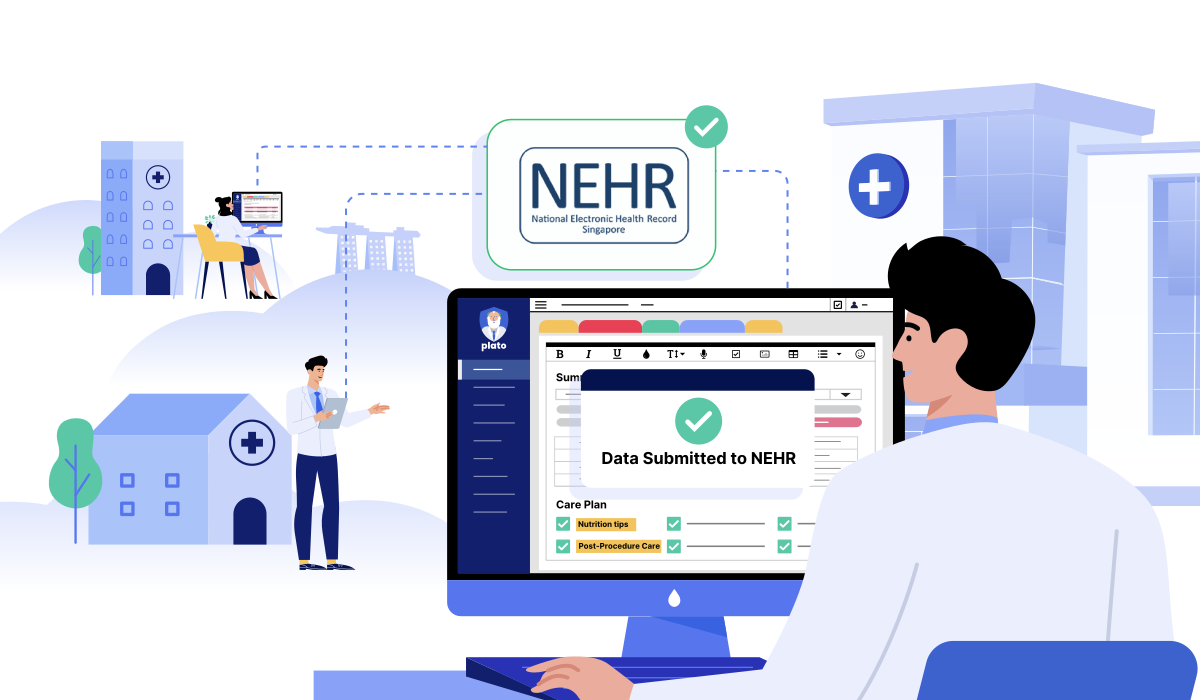
On 3 February 2026, Singapore's Health Information Act was enacted.One of the main purposes of the Health Information Act (HIA) was to provide the legal infrastructure governing how healthcare data will be shared across Singapore. The Health Information Act (HIA) specified that clinic software be HIA/HIMS Certified and it outlined when and how clinics would need to start contributing data to NEHR. This blog will help make it easy for your medical or dental practice to comply with HIA/HIMS requirements.
Plato is HIA/HIMS Certified
Before the Healthcare Information Act was passed, clinic software were governed by HCSE requirements (HCSE stands for Healthcare Cybersecurity Essentials). Plato was one of the first clinic software to be compliant with HCSE. Now, clinic software need to be HIMS-certified. Plato is also an HIA compliant / HIMS-certified vendor.
CSA (The Cybersecurity Agency of Singapore) regularly conducts a third party assessment of HIA Compliant / HIMS-Certified Vendors like Plato, to ensure that they build and deploy their software securely. Only secure software is allowed to submit data to NEHR. HIA Compliant / HIMS-Certified software like Plato are also given a Cyber Essentials Mark.
An HIA Compliant / HIMS-Certified Vendor, like Plato, must take the following measures:
-
Plato uses secure frameworks for managing its cloud infrastructure: HIA Compliant / HIMS-Certified vendors like Plato should have security and controls across data storage, APIs, cloud workloads, and third parties.
-
Plato uses best practices to manage data encryption: Plato uses in-flight and at-rest encryption to ensure that data is encrypted while it's being stored, accessed, and transferred by clinics.
-
Plato conducts vulnerability testing: Plato conducts vulnerability assessments and penetration testing, and improves its product based on testing results.
-
Plato makes strong access restrictions available for clinics (and uses these internally): Plato has robust access restrictions available for the clinic to set, and it uses these access restrictions internally as part of its data governance.
Only HIA/HIMs-Certified Vendors like Plato are allowed to submit data to NEHR
It will soon be mandatory for different HCIs (Healthcare Institutions) to submit data to NEHR. Here is a table of deadlines by which different HCIs will need to submit data to NEHR.
|
Deadline |
Clinic type |
Plato is linked with NEHR |
|
September 2027 |
Outpatient Medical Service (GP) |
√ Plato is linked with NEHR for Outpatient Clinics |
|
September 2027 |
Clinical Laboratory |
√ Plato is linked with NEHR for Clinical Laboratories |
|
September 2027 |
Radiology Laboratory |
√ Plato is linked with NEHR for Radiology Laboratory |
|
September 2027 |
Nuclear Medicine Service |
No software has been approved yet. Plato has completed the linkage for all data types. |
|
September 2028 |
Outpatient Medical Service (Specialist) |
√ Plato is linked with NEHR for Outpatient Medical Service (Specialist) |
|
September 2028 |
Outpatient Renal Dialysis |
No software has been approved yet. Plato has completed the linkage for all data types. |
|
March 2030 |
Outpatient Dental |
√ Plato is linked with NEHR for Outpatient Dental |
|
March 2030 |
Ambulatory Surgical Centre |
No software has been approved yet. |
|
March 2030 |
Assisted Reproduction |
No software has been approved yet. |
|
March 2030 |
Retail Pharmacy |
√ Plato is linked with NEHR for Retail Pharmacy |
Clinics submitting data to NEHR are eligible for an NEHR Connect Grant
Because Plato is HIA Compliant and HIMS-Certified, clinics using Plato to submit data to NEHR may be eligible for an NEHR Connect Grant. You can reach out to Synapxe here to find out more.
Oct 29, 2026